

Just like shopping for a new refrigerator, picking a linear equation solver in OpenSees (via the system command) can lead to paralysis of choice. And while you can consult Consumer Reports for the pros and cons of refrigerators A, B, and C, the only way to figure out the pros and cons of OpenSees solvers is to run your own test cases.
The solid bar model shown in this post is as good a test case as any other. Using successively refined mesh sizes of c=t/1.5, t/2, t/2.5, and t/3, with 585, 1200, 2304, 3894 equations, respectively, should give a good idea how well the various linear equation solvers perform. The model sizes are not very large because I want my crappy laptop to complete the analyses in reasonable time.
A static analysis of the bar model is performed for an increasing load (not important) over 10 pseudo time steps. I used more than one time step to cut down on variance in short run times. All things being equal, differences in run-time can be attributed to the equation solver.
The compute times reported in the plots below are wall times for all parts of the OpenSees analysis, not just the CPU time for only the solver.
It’s fairly well known that equation numbering can have a significant effect on linear equation solvers. But because the FullGeneral solver is so slow, all other solvers appear to perform equally well when using the RCM equation numberer.
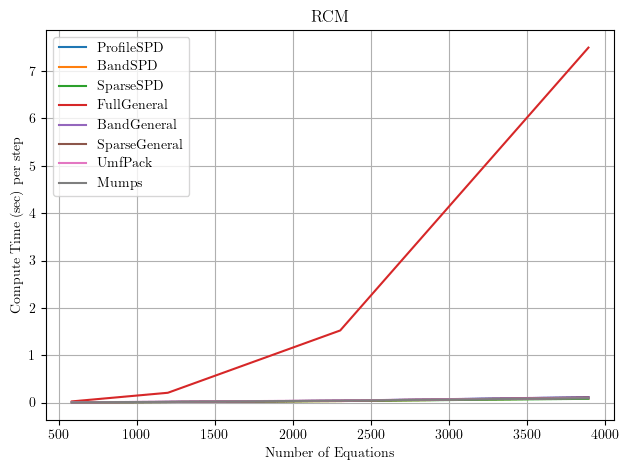
For reference, the stiffness matrix topology for the c=t/2 mesh size is shown in this post for the Plain, AMD, and RCM equation numberers available in OpenSees. Fortunately, RCM is the default option for the numberer command.
Changing the numberer to AMD, which leads to a large matrix bandwidth, the solvers start to sort themselves out.

Same deal with the Plain numberer.

It’s obvious from the foregoing results that the equation numberer affects the run-time significantly for some solvers, but has no effect on other solvers, indicating some solvers override OpenSees and use their own internal equation numbering.
We can get a better idea of what’s happening with equation numbering if we drill down to each solver.
ProfileSPD
The ProfileSPD solver uses profile matrix storage and assumes the matrix is symmetric and positive definite. This is the default option for the system command in OpenSees, I believe because Frank wrote the solver himself.

Assessment: Not so bad
BandSPD
The BandSPD solver is designed for symmetric, positive definite matrices and assumes banded matrix storage. For this model, the AMD numberer gives a slightly higher matrix bandwidth than the Plain numberer.

Assessment: Not so bad
SparseSPD
The SparseSPD solver assumes sparse storage of symmetric, positive definite matrices. As far as I know, this solver is one of the lesser used solvers in OpenSees. But perhaps the solver should be used a little more often. Note that this solver is not affected by the equation numbering provided by OpenSees.

Assessment: Good
FullGeneral
The FullGeneral solver assumes full matrix storage for general matrices. The equation numberer does not matter.
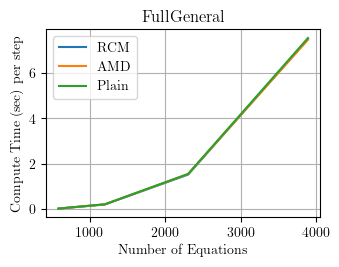
Assessment: The full general
BandGeneral
The BandGeneral solver assumes banded matrix storage for general matrices. Again, the AMD numberer leads to high bandwidth for this model.

Assessment: Not so bad
SparseGeneral
The SparseGeneral solver assumes sparse storage for general matrices. I would not expect the equation numberer to matter for sparse storage, but it does for some reason.
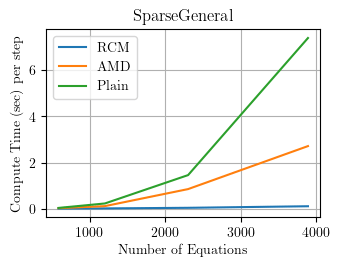
UPDATE (November 15, 2024): Based on input from Gustavo (see comments below), Frank updated the permSpec variable to be non-zero (commit 24147d3). Now the SparseGeneral solver gives the expected results.
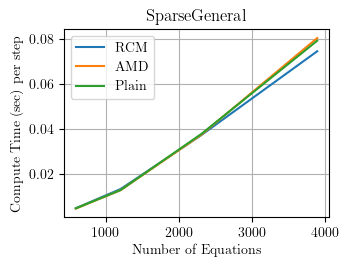
Assessment: Not so bad Good
UmfPack
UmfPack is a sparse matrix solver developed for general matrices. The solver is impervious to the OpenSees equation numbering.
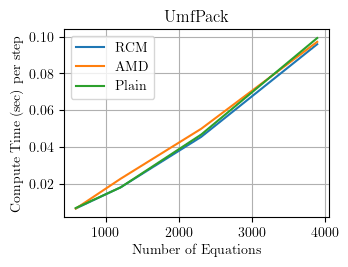
Assessment: Good
Mumps
Mumps is another general, sparse matrix solver, also indifferent to the equation numbering passed in by OpenSees.

Assessment: Good
That’s a quick run-down of the good, the bad, and the ugly among linear equation solvers in OpenSees. The SparseSPD and SparseGeneral solvers appear to be faster than UmfPack and Mumps for this model and analysis, but just like refrigerators, every solver has its pros and cons.
 Portwood Digital
Great post, Michael!
Some thoughts for your consideration:
From what I’ve read, equation numbering can matter quite a bit when it comes to minimizing fill-in during LU factorization in sparse solvers. Less fill-in means less memory usage and fewer operations for forward and backward substitution. Both SuperLU (used in SparseGeneral) and UMFPACK manuals mention different ordering strategies to reduce fill-in, which would override OpenSees’ built-in numberer. For example, Umfpack in OpenSees seems to use the “symmetric” strategy, where AMD is applied to A+A.T (see the UMFPACK User Guide, page 6). That might explain why the numberer doesn’t have much effect when using Umfpack in OpenSees.
Could the behavior you’re seeing with SparseGeneral be related to permSpec being set to 0 (natural ordering) in the SuperLU solver in OpenSees? The SuperLU manual lists different permutation strategies for different values of permSpec. I was wondering if using permSpec = 3 (AMD) might address the issue and bring its behavior closer to Umfpack’s.
Please let me know if I’m getting this right or if I am overlooking something.
LikeLiked by 1 person
Thanks, Gustavo!
SparseGeneral (SuperLU) should be fast no matter the equation numbering, so I suspected there was an option that was not set. I will try the analysis with permSpec = 3.
Michael
LikeLike
I spoke with el jefe this morning and showed him the SuperLU timings and shared your input on permSpec. Frank added
-permSpecas an optional input and made the default 1 instead of 0. Problem solved. ¡Muchas gracias!https://github.com/OpenSees/OpenSees/commit/24147d34c743ef82b459180e526c8a7af135401b
LikeLiked by 1 person
Awesome! Glad my input was helpful!
LikeLike
Thank you Prof. Scott for this amazing post.
I decided to perform some testing with my IDA of RC Wall buildings and there are noticeable differences in computing time from using different solvers. Particularly, comparing the BandGeneral with the SparseSPD nets an average reduction in our tests of 6.7%. That adds up a lot in our workflow.
LikeLiked by 1 person
Thank you! A 6.7% reduction in time is good, but not a lot. I guess the models are not very large and/or they are dominated by state determination, e.g., most time is spent in the fibers of the wall elements.
LikeLike
Indeed, the models are not large, very few DOF. But today we stumbled a very big 3D model of an tall RC building that includes slabs we plan to test. I will update with new info as soon as we get results.
LikeLike