

Unlike Linear and PDelta, rigid joint offsets are not an option for the Corotational geometric transformation in OpenSees. And the lack of corotational rigid offsets is not due to theoretical limitations, simply no one has taken the time to implement the equations. The two-dimensional case would not be terrible. But three-dimensional offsets? No thanks, not for me.
Until someone implements rigid offsets for the corotational transformation, just use stiff corotational frame elements. A simple test case can be found in Mesacasa et al (2012) from the proceedings of the 2012 SSRC Annual Stability Conference.
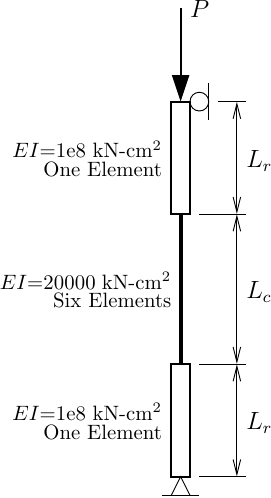
The column has two rigid end zones of length Lr around a flexible segment of length Lc. Similar to what the authors did in their SSRC paper, an OpenSees model is easy with a single elastic frame element with corotational transformation for the rigid ends and the center portion a corotational mesh of six elastic frame elements.
For the case where Lc=100 cm and Lr ranges from zero to 1.5Lc, the critical load (normalized by the Euler buckling load for Lc=100 cm and Lr=0) is shown below. Note that for this case, the total column length is 2Lr+Lc, increasing as the lengths of the rigid zones increase.
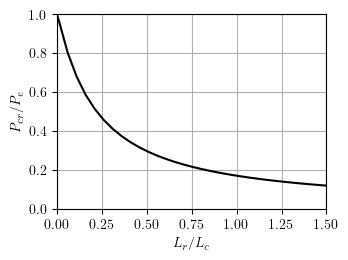
Compare these results to Figure 5 in Mesacasa et al (2012), where I am convinced the x-axis is mis-labelled as Lr/Lc ranging from 0 to 3 instead of 0 to 1.5. The OpenSees calculations check out with the closed-form solutions provided in the SSRC paper, so I’m certain the axis labels are incorrect. Worse errors have occurred in published materials. No big deal.
For the case where the total column length is held constant at 100 cm with Lr increasing relative to Lc, the normalized critical load is shown below.
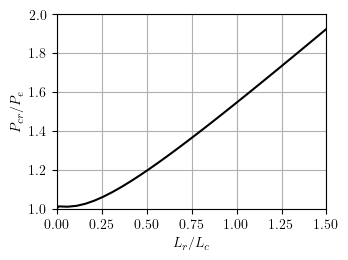
Compare these results to Figure 6 in Mesacasa et al (2012), where I am also convinced the range of the x-axis is mis-labelled.
 Portwood Digital
Very interesting post. I wondered why, in OpenSees, rigid offsets are not allowed with corotational.
In our recent study, we found out that there is also an alternative solution to stiff corotational elements. This method simply adjusts the quadrature rule in force-based elements to the length of the deformable portion, so that the flexibility of the remaining (rigid) parts is ignored. In OpenSees, this can be done with a ‘UserDefined’ beamIntegration.
LikeLiked by 1 person
Grazie, Paolo!
The method you mention only works for force-based elements where the offsets are collinear with the longitudinal axis. The stiff corotational elements are a more general solution for all element types and offsets in lieu of proper implementation.
Michael
LikeLike