

One of the most frequently asked OpenSees questions is whether node recorders record absolute or relative displacement (relative to the ground) when a model is subjected to a uniform excitation.
There’s several approaches to find the answer to this question.
One solution is to apply a simple uniform excitation–like a constant ground acceleration–to an SDF model, then plot what the node recorder records.
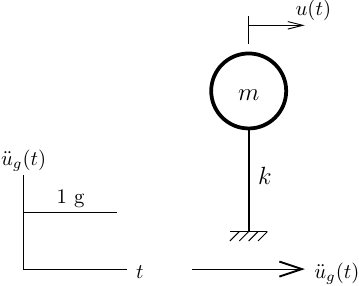
Here is the code for this SDF analysis, an MWE if you will.
import openseespy.opensees as ops

ops.wipe()
ops.model('basic','-ndm',1,'-ndf',1)

k = 400
m = 1
g = 386.4

ops.node(1,0); ops.fix(1,1)
ops.node(2,0); ops.mass(2,m)

ops.uniaxialMaterial('Elastic',1,k)

ops.element('zeroLength',1,1,2,'-mat',1,'-dir',1)

ag = 1.0*g
ops.timeSeries('Constant',1,'-factor',ag)
ops.pattern('UniformExcitation',1,1,'-accel',1)

tf = 1.0
dt = 0.001
Nsteps = int(tf/dt)

ops.recorder('Node','-file','SDFresponse.out','-time','-node',2,'-dof',1,'disp')

ops.analysis('Transient')
ops.analyze(Nsteps,dt)
At constant acceleration, 

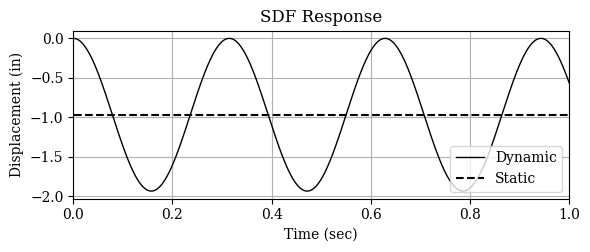
The displacement response does not increase quadratically and it’s nowhere near 193.2 inches. Instead, the displacement oscillates about the static, fixed base solution, 
Thus, the recorded displacement is relative to the ground for a uniform excitation. Same goes for the nodal velocity and acceleration.
OpenSees bonus points: the peak dynamic response is twice the static solution, as expected based on the closed form SDF solution for undamped, forced vibration with a step function.
OpenSees community, what approaches have you come up with in order to answer this question of relative or absolute displacement recorded by the node recorders?
 Portwood Digital
Prof. Scott, OpenSeesWiki and the GitHub version said that the recorder is recording absolute acceeleration (https://opensees.github.io/OpenSeesDocumentation/user/manual/output/NodeRecorder.html), are you sure about this?
LikeLike
I don’t see where the documentation says that, but you can always verify it for yourself.
LikeLike
Greetings Prof. Scott,
What Dong R.S says is found in Node Recorder, where it states that:
This cannot be found on the OpenSeesPy documentation, hence the confusion.
The ‘-timeSeries’ argument has to be omitted in a Node or Node Envelope recorder in order to obtain the relative accel / vel / disp, otherwise the absolute values are recorded.
LikeLike