

There are three applications of eigenvalue analysis in structural engineering. Vibration analysis and buckling analysis involve generalized eigenvalue analysis. OpenSees does vibration eigenvalue analysis pretty well, but does not perform buckling eigenvalue analysis–although you might be able to fake the geometric stiffness matrix for simple frame models.
The third application of eigenvalue analysis is ordinary (non-generalized) spectral decomposition of the material stiffness matrix, 


There are two approaches to finding the spectral decomposition of the stiffness matrix in OpenSees. The first approach is to use the default generalized eigenvalue solver in OpenSees after making the mass matrix equal to the identity matrix.
#
# Define your model
#

NDF = ops.getNDF()[0]
ones = [1]*NDF
for nd in ops.getNodeTags():
   ops.mass(nd,*ones) # 1,1,...,1

Nmodes = 2 ;# Or whatever
lam = ops.eigen(Nmodes)
The second approach is to use the 'symmBandLapack' option with the eigen command. This is not a generalized eigenvalue solver so you don’t have to worry about the “mass” matrix.
#
# Define your model
#

Nmodes = 2 ;# Or whatever
lam = ops.eigen('standard','symmBandLapack',Nmodes)
The 'standard' input is not entirely necessary. It’s there to make sure you’re aware the eigen command is not going to solve a generalized eigenvalue problem, like clicking “OK” before deleting a file.
There’s a third approach: get the stiffness matrix from printA, then use an eigenvalue solver in Python, e.g., scipy.linalg.eig. This is fine for getting eigenvalues, but you’ll have a hard time mapping the eigenvectors back to the structural model.
Consider a simple beam with two DOFs–the two end rotations. The stiffness matrix contains the basic stiffness coefficients 


The lowest eigenpair ![(2EI/L, [1,-1])](https://s0.wp.com/latex.php?latex=%282EI%2FL%2C+%5B1%2C-1%5D%29&bg=ffffff&fg=000000&s=0&c=20201002)
![(6EI/L, [1,1])](https://s0.wp.com/latex.php?latex=%286EI%2FL%2C+%5B1%2C1%5D%29&bg=ffffff&fg=000000&s=0&c=20201002)
After defining the model and calling the eigen command, you can use the nodeEigenvector command to see the components of the eigenvectors at each node.
import openseespy.opensees as ops

L = 120
E = 29000
A = 12
I = 800

ops.wipe()
ops.model('basic','-ndm',2,'-ndf',3)

ops.node(1,0,0); ops.fix(1,1,1,0)
ops.node(2,L,0); ops.fix(2,1,1,0)

ops.geomTransf('Linear',1)
ops.element('elasticBeamColumn',1,1,2,A,E,I,1)

lam = ops.eigen('-standard','-symmBandLapack',2)

print('Computed eigenvalues:',lam)
print('Expected eigenvalues:',2*E*I/L,6*E*I/L)

print('Eigenvector 1')
print(ops.nodeEigenvector(1,1,3),ops.nodeEigenvector(2,1,3)) # node, mode, dof
print('Eigenvector 2')
print(ops.nodeEigenvector(1,2,3),ops.nodeEigenvector(2,2,3))
The symmBandLapack eigenvalue solver gives the expected results.
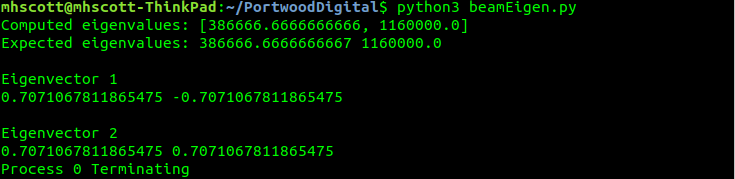
Note that the solver normalized the eigenvectors to have unit length.
 Portwood Digital
Hi, professor!
I have a question about eigen command.
In this post example, when symmBandLapack and fullGenLapack is used, the result is different respectively. So Which solver do we choose when we do eigenanalysis?
LikeLike
The post example has no mass, so the fullGenLapack will give you meaningless results.
LikeLike
Greetings Prof. Scott,
This topic is not discussed quite often in the literature, which leaves me with a couple of questions.
Thank you again for these great posts!
LikeLike
I’m not sure I understand your first question, but OpenSees maps eigenvectors to nodes via equation numbers.
For your second question, I believe ordinary eigenvalue analysis of structural models an interesting academic exercise, but not useful in practice. I saw this paper recently: https://link.springer.com/article/10.1007/s11831-024-10082-x
I do not know if this paper is worthwhile, but am leaving it here for my own future reference.
Also available on ResearchGate: https://www.researchgate.net/publication/381908806_Static_Modal_Analysis_A_Review_of_Static_Structural_Analysis_Methods_Through_a_New_Modal_Paradigm
LikeLike
Thank you Professor!
Regarding the first question, I was referring to this paragraph:
To clarify, my question have should been: “Why is it that scipy will give me a hard time mapping the eigenvectors, when compared to the OpenSees implementation?”
As to the second question, it may not be all that significant, but it sure is interesting. After some more digging, I was able to find in K-J Bathe’s “Finite Element Procedures” some more information on the topic.
Once again Professor, thank you kindly for your responses!
LikeLike
I see. The problem is you have to map the eigenvectors from scipy back to the equation numbers in OpenSees, which are generally not 1,2,3,… at node 1, 7,8,9 at node 2, etc.
LikeLike