

Thanks to my involvement with OpenSees, I have been asked to review several manuscripts on nonlinear dynamic structural analysis. It’s always wonderful to see what other researchers are up to and how they use OpenSees or other software to achieve their research objectives.
A brief overview of the governing dynamic equilibrium equation, i.e., the equation of motion, is standard in the manuscripts I’ve reviewed–and in this post. For the common case of linear damping and inertial forces, nonlinearity comes from only the static resisting force vector, 


Unfortunately, a few manuscripts I’ve reviewed get the equation of motion wrong by expressing the static resisting force vector as 


This equation tries to fit a changing stiffness matrix into the framework of linear dynamic structural analysis. Yes, nonlinear analysis can be viewed as a sequence of linear analyses, but not in that way. The difference between these two expressions for the static resisting force vector can be significant.
Consider case (a) in the figure below, where the static resisting force is in a state of loading. The solid circle is the correct static resisting force, 
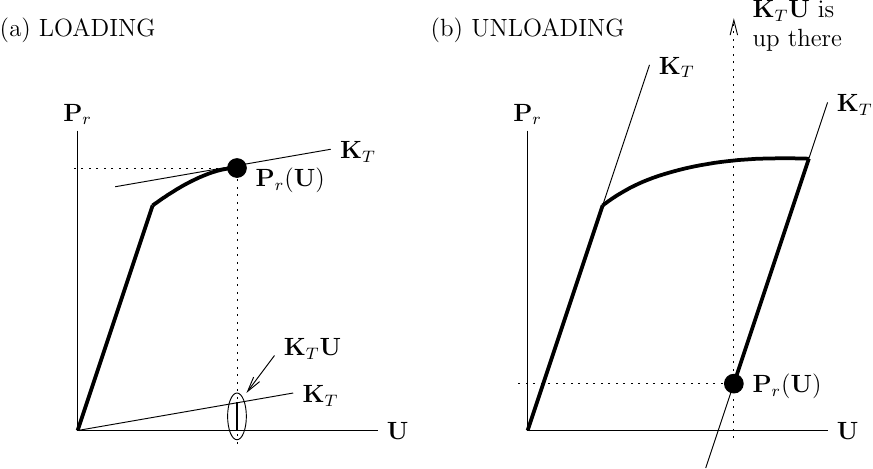
Now consider case (b), where the static resisting force is unloading with its initial stiffness. After forming a triangle from the displacement and the tangent stiffness at the origin, the incorrect
The figure is a single degree of freedom representation of a multi-dimensional problem. So, instead of magnitudes, signs, and triangles, let visions of norms, vectors, and hyperplanes dance in your head.
Although they use software that computes the correct static resisting force, it’s possible the authors don’t realize their error. If I see the incorrect equation of motion when reviewing a manuscript, my review decision is easy–I try to be constructive and not too snarky in my review comments. But would you trust the interpretation of results made by authors who do not express the equation of motion correctly?
 Portwood Digital
If what you tell here is not correct, you may be misleading people. In example, did you try dividing the external load (incrementation) in the loading example?
LikeLike
It is correct. It is not misleading.
LikeLike
If you do not use stiffness times displacement and use a resisting force vector, then you do not calculate a stiffness matrix for elements, right? You do not calculate the stiffnesses of beams, columns, plates, shells, you calculate force vectors. Then, in example you do not invert a stiffness matrix in implicit time integration, since you do not have a stiffness. Also, this page should be corrected, it states “eqilibrium equation for the finite element system in motion at time t:
LikeLike
Thank you for this explanation. I confess, I didn’t realize my error until now 😦
LikeLike