
OpenSees is not built to perform linear buckling analysis. But a few years ago, Luigi Caglio shared a workaround described in this post.
In the post, the example application is a frame model, but there’s no reason the approach cannot work for shell models. So, here’s a minimal working example.
Consider a rectangular steel plate with simple boundary conditions and compressive axial load. The elastic modulus is E=29,000 ksi and the Poisson ratio is 0.3. The plate length, width, and thickness are L=50 inch, h=8 inch, and t=1 inch, respectively.

A mesh of geometrically nonlinear ShellNLDKGT elements is defined below using the mesh command shown in this post.
import openseespy.opensees as ops
import numpy as np
import scipy.linalg as slin

# Plate dimensions
L = 50.0
h = 8.0
t = 1.0

# Material properties
E = 29000
v = 0.3

ops.model('basic','-ndm',3,'-ndf',6)

ops.node(1,0,-h/2,0)
ops.node(2,0,h/2,0)
ops.node(3,0,h/2,L)
ops.node(4,0,-h/2,L)

c = h/4 # Mesh size

ops.mesh('line',1,2,*[1,2],0,6,c)
ops.mesh('line',2,2,*[2,3],0,6,c)
ops.mesh('line',3,2,*[3,4],0,6,c)
ops.mesh('line',4,2,*[4,1],0,6,c)

ops.section('ElasticMembranePlateSection',1,E,v,t)

ops.mesh('quad',13,4,*[4,3,2,1],0,6,c,'ShellNLDKGT',1)

ops.fixZ(0,1,1,1,0,0,0) # bottom nodes, Z=0
ops.fixZ(L,1,1,0,0,0,0) # top nodes, Z=L

ops.fix(1,0,0,0,1,0,0)
The last fix command restrains one drilling DOF in the model in order to avoid artificially low eigenvalues.
Before applying any loads, we can get the material stiffness for the plate using the printA command.
ops.integrator('LoadControl',0.0)
ops.system('FullGeneral')
ops.analysis('Static','-noWarnings')
ops.analyze(1)

N = ops.systemSize()
Kmat = np.array(ops.printA('-ret')).reshape((N,N))
We can now apply a unit reference load, get the stiffness matrix again accounting for geometric nonlinearity, then obtain the geometric stiffness matrix by subtracting off the material stiffness.
endNodes = ops.getNodeTags('-mesh',3) # tag 3 = line mesh across top of plate
Pref = 1
dP = Pref/len(endNodes)

ops.timeSeries('Constant',1)
ops.pattern('Plain',1,1)
for nd in endNodes:
    ops.load(nd,0,0,-dP,0,0,0)

ops.analyze(1)

Kgeo = np.array(ops.printA('-ret')).reshape((N,N))

Kgeo = Kmat-Kgeo
Finally, we call the eig() function from the scipy.linalg package, then find the minimum positive eigenvalue (the critical buckling load) and the index of the corresponding eigenvector which will correspond to the buckled shape.
lam, x = slin.eig(Kmat,Kgeo)
lamPos = lam[lam>0]
xPos = x[:,lam>0]

lamMin = min(lamPos)
lamMinIndex = lamPos.argmin()
For this analysis, the computed buckling load (lowest eigenvalue) is 76.7 kip while the exact flexural buckling load is 
After some low-level gymnastics mapping equation numbers from the critical eigenvector back to nodes of the OpenSees model, we can view the buckled shape.
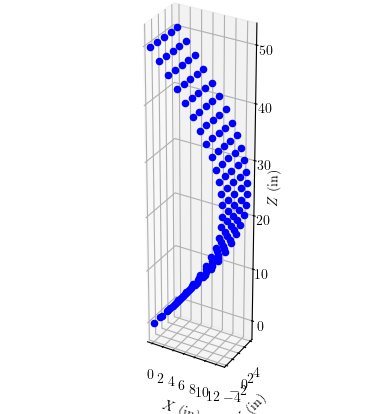
Looks correct to me!
 Portwood Digital
Good afternoon, Professor Scott,
I hope you’re doing well. I found this example particularly interesting as it clearly illustrates the method proposed by Luigi Caglio to determine critical loads and buckling modes for shell elements.
Some time ago, I conducted a few tests with this element. However, as far as I remember, it might not be possible to carry out a linear buckling analysis with ShellNLDKGT, since it updates the basic coordinate system of the element during the analysis, introducing geometric nonlinearity. Perhaps in this specific case the effect is negligible, but I recall situations where it prevented me from obtaining accurate critical buckling loads.
I could certainly be mistaken, and I would really appreciate your thoughts on this.
Best regards.
LikeLike
Hello Alfonso,
Thank you for the note. I’m not sure what type of buckling analysis you attempted before with the ShellNLDKGT, but the updateBasis() method is necessary for the element to account for geometric nonlinearity. If you have a simple example of what you tried previously, feel free to share.
Michael
LikeLike
I can’t seem to find any documentation on updateBasis(). Could you expand a bit on how it’s used?
Thanks!
LikeLike
Nice!
LikeLiked by 1 person